In what I think is now the longest running series of posts on this blog, I’m back reviewing documents relating to Gloucestershire’s Javelin Park Incinerator saga (see here). This is a long and particularly wonky post, put together quickly ahead of tomorrow’s Audit Committee Meeting. I’ll try and draw out some of these ad-hoc observations into something more accessible soon.
A brief history
To put the latest developments in context:
- In June 2017, Grant Thornton, the County Councillors auditors, accepted an objection to the Council’s accounts (under schedule 7 of the Local Audit and Accountability Act 2014) made by Community R4C.
- In December 2018, GCC dropped an appeal to the Information Tribunal to keep the details of a revised 2016 contract secret, leading to the revelation of over £150m cost increase in the contract.
- In early 2019, over 350 signed an open letter calling for an independent inquiryinto the project. This was rejected, in part on the grounds of an ongoing audit process and legal proceedings (see below).
- In January 2019, Community R4C issued legal proceedings based on the new information: calling for a renegotiation of the contract and nominal damages. Preliminary hearings for the case concluded in July 2020, with the judgement that CR4C did not have ‘standing’ to bring the case (i.e. as only ‘economic operators’ affected by a failing of procurement law can bring a case, the predominantly public-interest case brought by CR4C was ineligible.). CR4C appealed, but that appeal was rejected asked to appeal, but were denied permission to, [Correction: 29/09/21] in November 2020.
- In parallel to the legal route, Cllr Rachel Smith (Green), secured a discussion of the new information at the Overview & Scrutiny Management Committee in March 2019, in which the Chief Executive admitted the council had been in a weak negotiating position for the contract revisions.
- The audit report from Grant Thornton has been persistently delayed, in part due to a lack of information provision by the local authority and restrictions on sharing that information with the objectors, and since 2019, to allow conclusion of the court case.
- The report was further delayed (without clear explanation) from it’s expected publication just before the most recent local elections, causing the Chair of Audit Committee to issue a storngly worded statement accusing the authority of supressing reporting for political reasons.
- A final response to the audit challenge is coming before the Audit and Governance Committee next week.
The Auditors response stops short of issuing a ‘Report in the Public Interest’, and triggering the associated public meetings. This appears to be at odds with the outcome that the objectors, Community R4C had expected based on their access to earlier drafts of the report from the auditor which concluded that a Public Interest Report was required [Addition: 29/09/21].
This post is my notes from reading the auditors letter and report.
What does the report find?
In short, the auditors conclude that they cannot draw a definitive conclusion with respect to audit objections:
- Because of the length of time passed since the contract was signed;
- Because of the complexity of the contacts financial model, and the assumed cost of assessing whether it’s renegotiation in 2016 shifted the economic balance in favour of the operator (UBB);
- Because other Energy from Waste contracts are not transparent, making comparison to other authority contracts difficult.
They write that:
” our main objective is to explain why we have not reached a definitive conclusion, rather than to express such a conclusion,”
although then then state that:
“we do not consider that anything further by way of public reporting and consideration by a Committee of the Council is required”
with perhaps an implicit suggestion it seems that the council wanted to avoid public reporting of this at all?
However, on the substantive matters, the report finds (page 12):
- The council conclusively did not consider whether the 2016 renegotiation shifted the economic balance in favour of UBB
- The auditors consider it would have been appropriate to conduct such an assessment and to keep records of it;
- The auditor does not agree with the council’s legal opinion that it was not required to produce such an assessment, but accepts that the council was acting on its own legal advice.
They go on to say:
“From an audit perspective, a decision making process followed by a council which accorded with its legal view at the time is not in itself necessarily a cause for concern simply because that legal view may have been erroneous. Such a process does not necessarily indicate that the council lacks appropriate internal procedures for ensuring the sound management of its resources.”
So, whilst the council relying upon faulty legal advice for a 25-year contract appears not to be grounds for a negative independent audit conclusion – it should surely be a significant matter of serious concern for the Audit and Governance Committee.
Put another way, the auditors conclude that:
“Our view, in line with the advice we have received from independent Counsel, is that the material we have so far considered is insufficient to enable us to reach a firm conclusion as to the lawfulness under procurement law of the modifications.”
Which, although it appears nothing can now be done to exit the Javelin Park contract, leaves at 25-year, £600m commitments by Gloucestershire Taxpayers under a significant cloud.
Establishing the legality of their actions is surely the least we should expect from our local authorities, let alone establishing that they operate in the best-interests of local residents and the wider environment.
It is also notable that, had the authority not fought against disclosure of contract details until late 2018, more contemporary examination of the case may have been possible, lessening the auditors objection that too much time has passed to allow them to conduct a proper investigation. The auditor however studiously avoids this point by stating:
“It is not our function to ‘regulate’ the Council in terms of whether it is sufficiently committed to transparency, or whether it has unjustifiably refused to release information in response to Freedom of Information Act requests.”
Yet, transparency is a central part of our public governance arrangements (not least in supporting meaningful public engagement with audit objections), and for it to fall entirely outside the scope of auditors comments about whether processes were robust is notable.
Observations to explore further
As I’ve read through, a few different things have struck me – often in connection with past documents I’ve reviewed. I’ve made brief notes on each of these below.
Wider procurement issues
Page 12 of the letter states “We have not seen evidence that suggests that there may be a pattern of non-compliance with procurement law by the Council.”but does not detail whether any evidence was sought, or what steps were taken to be satisfied as to this conclusion. Notably, public news reports covering the periods 2015 – 2019 highlight other governance failings related to procurement (though not necessarily procurement law), and at least from a public perspective raise some red flags about whether appropriate controls and oversight have been in place at GCC.
Recycling incentives
On page 19, considering the impact of the contract on incentives to recycle states that:
“While the average cost per tonne does clearly reduce as the level of waste increases, which may be as a result of lower recycling rates, the Council does not have direct influence over recycling rates.”
This appears at odds with the fact the authority provide Waste Incentive Payments to Waste Collection Authorities designed to influence recycling rates, and that these rates have been altered since the Incinerator became operational.
What’s a fair comparison?
A considerable part of the case the Council rely upon to prove Value for Money of the incinerator is the report produced by EY that compares the cost of the renegotiated 2016 contract with the cost of terminating the contract and relying on landfill for the next 25 years.
The auditors note that:
“the Council was professionally advised during the negotiation process, including by EY on the VfM of the RPP in comparison to terminating the contract and relying on landfill.”
However, the scope of the EY report, which compares to the “Council’s internal Landfill Comparator” (see covering letter) was set not on the expert advice of EY, but at the instruction of the Council’s procurement lead, Ian Mawdsley. As I established in a 2019 FOI, when I asked for:
the written instructions (as Terms of Reference, e-mail confirmation or other documentary evidence) of the work that was requested from Ernst and Young. Depending on the process of commissioning this work, I would anticipate it would form a written document, part of a work order, or an e-mail from GCC to E&Y.
and the council replied:
“We have completed our investigation into the points you raise and can confirm that the council do not hold any separate written terms of reference as these were initially verbal and recorded in the document itself.
It seems reasonable to me that an expert advisor, given scope to properly consider alternatives, may have been able to, for example, compare termination against short-term landfill, followed by re-procurement. This should have been informed by the outcome of the Residual Waste Working Group Fallback Strategy that considered alternatives in 2013, but appears to have been entirely ignored by the Council administration.
If the council is to rely on ‘expert advice’ to establish that it, in good faith, sought to secure value for money on the project – then the processes to commission that advice, and the extent to which consultants were given a brief that allowed them to properly consider alternatives, should surely be considered?
Cancellation costs are a range: where are the error bars?
The auditor briefly considers whether councillors were given accurate information when, in meetings in 2015, they were debating contract cancellation costs of £60m – £100m.
My reading of the EY report, is that, on the very last page, it gives a range of possible termination costs for force majeure planning permission-related termination, with the lowest being £35.4m (against a high of £69.8m). Higher up, it reports a single figure of £59.8m. The figure of £100m is quoted as relating to ‘Authority Voluntary Termination’ by EY note they have not calculated this figure in detail. It therefore seems surprising to me for the auditors to conclude that, a meeting in 2015 considering contract cancellation, that was not provided with an officer report explaining either figure, but being told that cancellation costs were in the range £60m to £100m was:
“not distorted by inaccurate information.”
As surely the accurate information that should have been presented would have simply been:
- EY have produced estimated costs in a range from £35.4m – £69.8m if we cancel due to passing the planning long-stop date. Their best estimate for a single figure in this range of £59.8m
- EY have produced a rough estimate (but no calculations) of a cost of £100m if the authority cancels for other reasons outside the panning delay.
- The council estimates that sticking with landfill for a period of time, and carrying out another procurement exercise could add up to X to the cost.
Eversheds advice
Re-reading the EY report, I note that it refers to separate advice provided by Eversheds on the issues of State Aid, Documentation Changes and Procurement risks including risks of challenge.
To my knowledge this advice has never been put in the public domain. It may be notable however, that the auditor does not reference this advice in their reply on the objectors allegation that the contract could have constituted illegal state aid.
Perhaps another FOI request if someone else wants to pick up the baton on that?
We should have recorded meetings!
I was present at the March 2019 meeting when the chief executive admitted that the council were in a poor negotiating position in relation the contract. My partner, Cllr Smith, raised the failure of the minutes to include this point at the subsequent meeting but it appears the administration were already attempting to remove this admission from the record.
Whilst the auditor states:
“In our view, even assuming that such a statement was made by the Chief Executive (and we make no finding as to whether it was: we note that the Council does not accept that your record of the meeting is accurate), it would not in itself justify our making a finding that the contract modifications shifted the balance of the contract in UBB’s favour.”
That this point is addressed, and that the Council administration have attempted to keep admissions in a public meeting of their weak negotiation position from the record, is of note.
With hindsight, given the Council chose to hold this meeting in a room that was not webcast, we should have arranged independent citizen led recording of the meeting.
A problem with facts?
The final line of the auditors letter, in their reasons for not seeking to make an application to the court for a declaration that council acts may have been against the law is rather curious:
“the issues underlying these matters are very fact specific such that there would be limited wider public interest in a court declaration.”
An argument for or against Open Contracting?
The report appears to make a strong case for wholesale Open Contracting when it comes to large EfW projects. They state:
“We accept that the comparisons included in the WRAP report do have significant limitations, mainly because they are, as the Council notes, quoted at a point in time and in isolation from the underlying contractual terms such as length of contract, risk share etc. Without access to such information on the contracts in place elsewhere, it is impossible to do a conclusive comparison, and even with full information on the various contracts, there would still be a good many judgements and assumptions involved in making a comparison because of, for example, variations in the ‘values’ associated with particular risks.”
In other words – the lack of transparency in Energy from Waste projects makes it nearly impossible to verify that the waste ‘market’ (which, because of geographical constraints and other factors is a relatively inflexible market in any case), has generated value for money for the public.
I’m also not sure why ‘values’ gets scare quotes in the extract above…
However, it appears to me that, rather than calling for greater publication of contracts, the auditors want to go the other way, and argue that contracting transparency could be bad for local authorities:
“Procurement law pursues objectives that are wider than promoting the efficient use of public resources. In particular, procurement law, as applicable at the relevant time, sought to pursue EU internal market objectives and to ensure the compliance of EU member states with obligations under the World Trade Organisation Global Procurement Agreement, by ensuring that contract opportunities were opened up to competition and that public procurement procedures were non-discriminatory and transparent. In some circumstances, public procurement law could potentially operate to preclude an authority from selecting an approach which could reasonably be regarded by the authority as the most economically efficient option available to it in the circumstances.”
This critique of the laws ‘as applicable at the relevant time’ (i.e. during EU membership) also raises a potential red flag about arguments post-Brexit Britain may increasingly see.
Is Local Audit Independent and Effective?
I recall hearing some critique of Grant Thornton’s audit quality – and struck by some of my concerns about how this objection letter reads, did a brief bit of digging into the regulators opinion.
In 2019/20, the Financial Reporting Council reviewed six local audits by Grant Thornton. None were fully accepted, with the regulator concluding that:
Thee audit quality results for our inspection of the six audits are unacceptable, with five audits assessed as requiring improvement, although no audits were assessed as requiring significant improvement.
going on to note that:
“At least two key findings were identified on all audits requiring improvement and therefore areas of focus are the audit of property valuation, assessment and subsequent testing of fraud risks, audit procedures over the completeness and accuracy of expenditure and EQC review procedures.”
Whilst this does not cover assessment of the quality of reports in relation to audit objections, it is notable that in their response to the report Grant Thornton state:
“We consider that VfM audit is at the centre of local audit. We take VfM work seriously, invest time and resources in getting it right, and give difficult messages where warranted. In the last year, we have issued a Report in the Public Interest at a major audit, Statutory Recommendations and Adverse VfM Conclusions.”
Yet, in the Gloucestershire case, the auditors failed have studiously avoided asking any substantive Value for Money questions about the largest ever contract for the local authority, either at the time the contract was negotiated, or following concerns raised by objectors.
In their response to objectors, Grant Thornton rely a number of times on the time elapsed since the contract was signed as a reason that they cannot conduct any VfM analysis. Yet, they were the auditors at the time significant multi-million capital sums were committed the project: which surely should have triggered contemporary VfM questions?
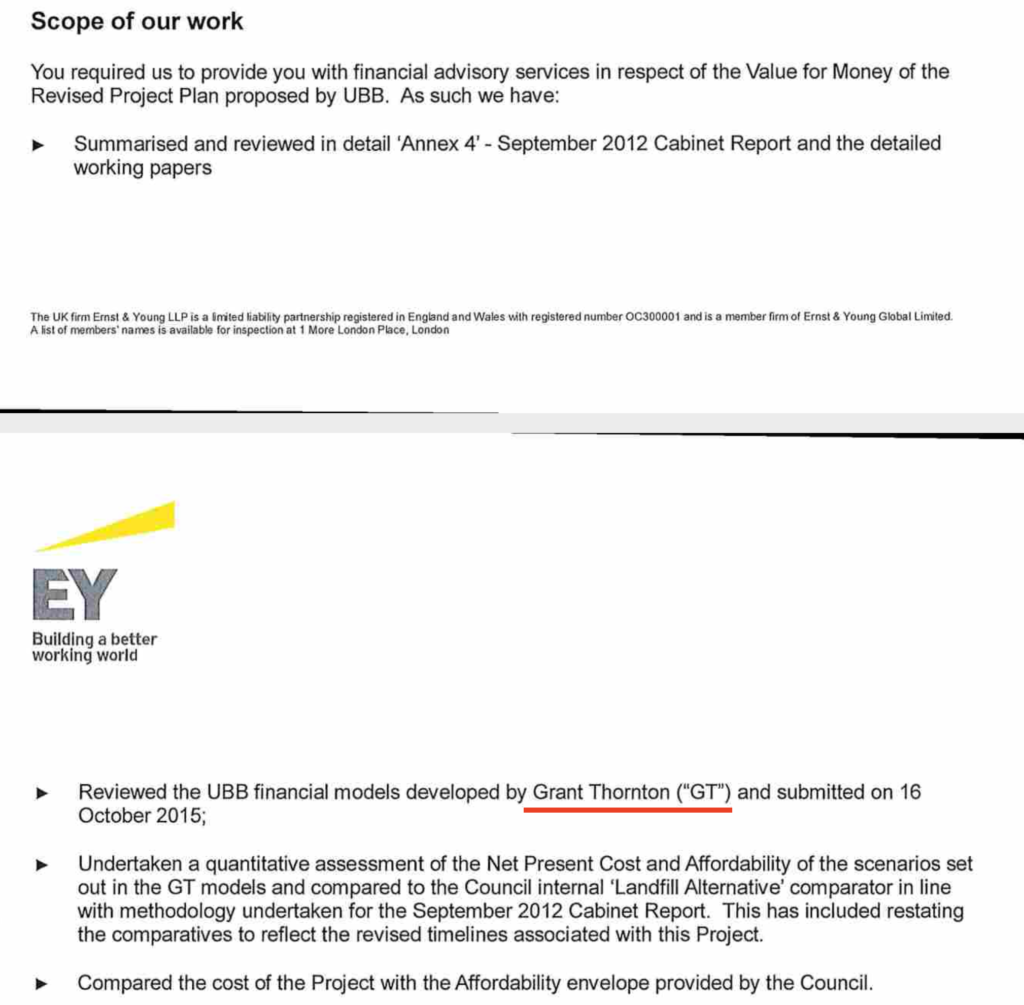
It’s notable that local electors are being asked to trust that Grant Thornton have very robust processes in place to protect against conflict of interest, not only because a finding that VfM was not secured would surely call into question the comprehensiveness of Grant Thornton’s past audit work (none of which is referenced in the report) and because, as we learnt from the £1m Ernst and Young Report relied upon to assert that the council had sought suitable independent advice, the financial models of Incinerator operator UBB were written by, none other than, Grant Thornton.
(Oh, and today’s news on Grant Thornton doesn’t add to public confidence either.)
Effective objection, and the need for dialogue
One thing that has come across in years of reading the documents on this process, from Information Tribunal rulings, Court rulings and the Auditors letter, is the ‘frustration’ of the authorities (e.g. Judges, Auditors) being asked to ‘adjudicate’ in this case with one or other of the parties. At times, the Council has come in for thinly veiled or outright criticism for lack of co-operation, and Community R4C appear to have at times undermined their case by making what the auditors view as excessive or out-of-scope objections.
A few takeaways from this:
- There is a high bar for citizen-objectors to clear in making effective objections, and little support for this. Community R4C have drawn on extensive pro-bono legal advice, crowd-funding and other resources – and yet their core case, that the project is neither Value for Money, nor in-line with the waste hierarchy, has never been properly heard: always ruled out of consideration on ‘technicalities’.
- Objection processes need to be made more user-friendly: and at the same time, objectors need to be supported with advice and even intermediaries who can help support filtered and strategic use of public scrutiny powers.
- The lack of openness from Gloucestershire County Council to dialogue has been perhaps the biggest cause of this saga running on: leading to frustrating, irritable and costly interactions through courts and auditors – rather than public discussion of constructive ways forward for waste management in the County.
Where next?
I’ll be interested to see the outcome of tomorrow’s meeting of the audit committee, where, even though there were only a few hours between the report and question deadline, I understand there will be a substantial number of public questions asked.
My sense is there still remains a strong case for an independent process to learn lessons from, what remains to my mind, a likely significant set of governance failures at Gloucestershire County Council, and to ensure future waste management is properly in line with the goal of increased recycling and waste reduction.